

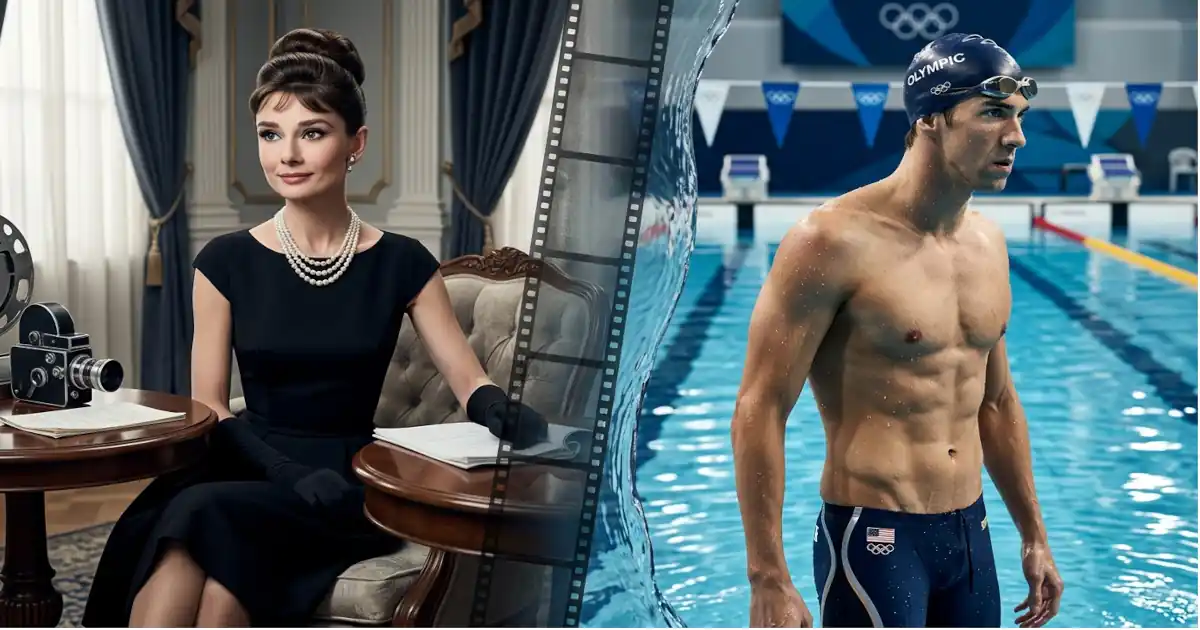
Few names carry as much cultural weight as Audrey Hepburn and Michael Phelps. One ruled the world of cinema and fashion. The other dominated the pool like no athlete before him. Together, their stories reveal what true greatness looks like across generations. This article explores their lives, careers, and lasting impact on popular culture.
Who Was Audrey Hepburn?
Audrey Hepburn was born in Brussels in 1929. She grew up during a turbulent period in European history. World War II shaped her early years in profound ways. She experienced hunger, fear, and loss as a child. These hardships later fueled her deep empathy for others. Hepburn began her career as a ballet dancer in London. She soon shifted toward acting and modeling work. Her breakout role came in “Roman Holiday” in 1953. The film earned her an Academy Award for Best Actress. Audiences instantly fell in love with her elegance and charm.
She went on to star in unforgettable films. “Breakfast at Tiffany’s” remains one of her most iconic roles. “Funny Face” and “Sabrina” further cemented her Hollywood legacy. Her fashion sense also became globally influential. Designer Hubert de Givenchy dressed her in many films. Their partnership defined an entire era of style. Critics often praised her natural, understated acting style. She avoided melodrama and relied on subtle expression instead. This approach made her performances feel timeless and believable. Directors valued her professionalism and quiet confidence on set. Co-stars frequently described her as gracious and easy to work with. These traits made her one of the most respected actresses of her time.
Who Is Michael Phelps?
Michael Phelps was born in Baltimore in 1985. He started swimming competitively at a very young age. His talent became obvious almost immediately to coaches. By age 15, he had qualified for the Olympics. This early start set the stage for historic achievements. Phelps went on to dominate international swimming for two decades. He won eight gold medals at the 2008 Beijing Olympics. This feat broke a record that stood for 36 years. Across his career, he earned 23 Olympic gold medals total. No other athlete in history has matched that number.
His discipline and work ethic became legendary in sports circles. Coaches often cite his training routine as extraordinary. Phelps trained for hours every single day of the year. That relentless dedication turned him into a global sports icon. His physical build also gave him a natural edge. A long wingspan and large hands aided his stroke. Analysts often studied his technique to understand his dominance. Even after retirement, his records remain largely untouched. Younger swimmers still measure their progress against his times. His name is now a permanent benchmark in the sport.
Audrey Hepburn and Michael Phelps: A Study in Contrast
Audrey Hepburn and Michael Phelps built their fame in very different fields. One captivated audiences through film and fashion. The other captivated the world through speed and endurance. Yet both achieved something rare in their respective industries. They became symbols that transcended their original professions.
Hepburn’s influence extended far beyond the screen. She became a global fashion reference point for decades. Phelps, meanwhile, redefined what athletic excellence could look like. His name is now synonymous with Olympic greatness. Both figures prove that mastery can create lasting global recognition.
Their timelines also differ in interesting ways. Hepburn rose to fame in the golden age of cinema. Phelps emerged during the modern era of televised sports. Media coverage of each era shaped how audiences saw them. Hepburn’s image spread through film reels and magazines. Phelps’s achievements spread instantly through television and digital media.
Struggles Behind the Spotlight
Fame often hides personal battles from public view. Audrey Hepburn faced serious health challenges during her childhood. Malnutrition during the war affected her for years afterward. She also dealt with personal loss and difficult relationships. Despite this, she maintained a graceful public presence.
Michael Phelps faced his own struggles later in life. He has spoken openly about depression and anxiety. His mental health battles surprised many of his fans. Public pressure and constant competition took a heavy toll. Phelps eventually sought therapy and support to recover.
Their willingness to discuss hardship humanized both stars. Each of them showed that success does not erase pain. Fans connected with their honesty about difficult moments. This openness added depth to their public personas. Vulnerability, it turns out, can strengthen a legacy rather than weaken it.
Humanitarian Work and Advocacy
Audrey Hepburn dedicated her later years to humanitarian causes. She served as a UNICEF Goodwill Ambassador starting in 1988. Hepburn traveled to some of the world’s poorest regions. She advocated for children affected by war and famine. Her humanitarian legacy remains as strong as her film career.
Michael Phelps has also embraced advocacy work in recent years. He focuses heavily on mental health awareness today. Phelps founded a foundation to support children’s wellness programs. He frequently speaks about therapy and emotional resilience. His platform now extends well beyond competitive swimming.
Both figures used their fame to help vulnerable communities. Audrey Hepburn and Michael Phelps turned personal experience into public service. Their advocacy work adds another layer to their legacies. It shows that celebrity status can drive meaningful change.
Hepburn’s field visits often included Ethiopia, Somalia, and Bangladesh. She met directly with children facing famine and disease. Her reports helped raise global awareness of humanitarian crises. Phelps, in turn, visits schools and clinics to discuss mental wellness. He encourages young people to speak openly about their struggles. Both approaches show that fame can serve a larger purpose.
Cultural Influence and Lasting Legacy
Audrey Hepburn’s image remains iconic decades after her passing. Her little black dress from “Breakfast at Tiffany’s” is legendary. Fashion designers still reference her style choices today. Magazines regularly feature her among history’s most elegant women. Her humanitarian work also continues to inspire new generations.
Michael Phelps redefined expectations for Olympic athletes everywhere. Young swimmers train with his achievements as a benchmark. His name appears frequently in sports documentaries and media. Brands continue partnering with him for global campaigns. His influence on swimming culture remains unmatched.
Comparing Audrey Hepburn and Michael Phelps highlights two very different paths to legend status. One achieved timeless elegance through cinema and style. The other achieved unmatched dominance through speed and discipline. Both left legacies that outlived their active careers.
Lessons from Their Journeys
Their stories offer valuable lessons for anyone pursuing excellence. Hard work and discipline drive success in any field. Both stars faced setbacks before reaching the top. Neither let early struggles define their entire journey. Their resilience became a defining trait of their careers.
Authenticity also played a major role in their popularity. Audiences connected with their honesty and vulnerability. Fans respected them for staying true to themselves. This authenticity helped build long-lasting public trust and admiration.
Patience proved just as important as talent for both stars. Hepburn spent years refining her craft before major stardom. Phelps spent a decade training before reaching his Olympic peak. Their gradual rise reminds readers that success rarely happens overnight. Consistent effort, repeated daily, eventually produces extraordinary results.
Giving back proved equally important for both icons. Neither one stopped at personal achievement alone. They used their platforms to support others in need. This generosity strengthened their reputations far beyond their industries. Their example shows that legacy is built through service, not applause alone.
Why People Still Compare Them Today
Online searches often pair unlikely public figures together. These two names frequently appear in such comparisons. Curious readers want to understand what defines true greatness. Comparing different eras and industries offers valuable perspective. It highlights universal traits shared by successful people everywhere. It also shows why some legacies simply refuse to fade with time.
Both figures represent peak performance in their respective crafts. Their combined story shows that greatness has many forms. Whether through art or athletics, dedication remains essential. Readers continue to find inspiration in both legacies.
Final Thoughts
Audrey Hepburn and Michael Phelps remain two of the most recognizable names in history. Their achievements span completely different industries and eras. Yet both share qualities that define true icons. Discipline, resilience, and generosity connect their otherwise separate stories.
Their legacies continue to inspire fans around the world. Hepburn’s grace and Phelps’s determination still resonate today. Together, they remind us that greatness comes in many forms. Their stories will likely inspire generations for years to come.
READ ALSO: PlayMyWorld Latest News: Everything Gamers Need to Know






Leave a Reply